

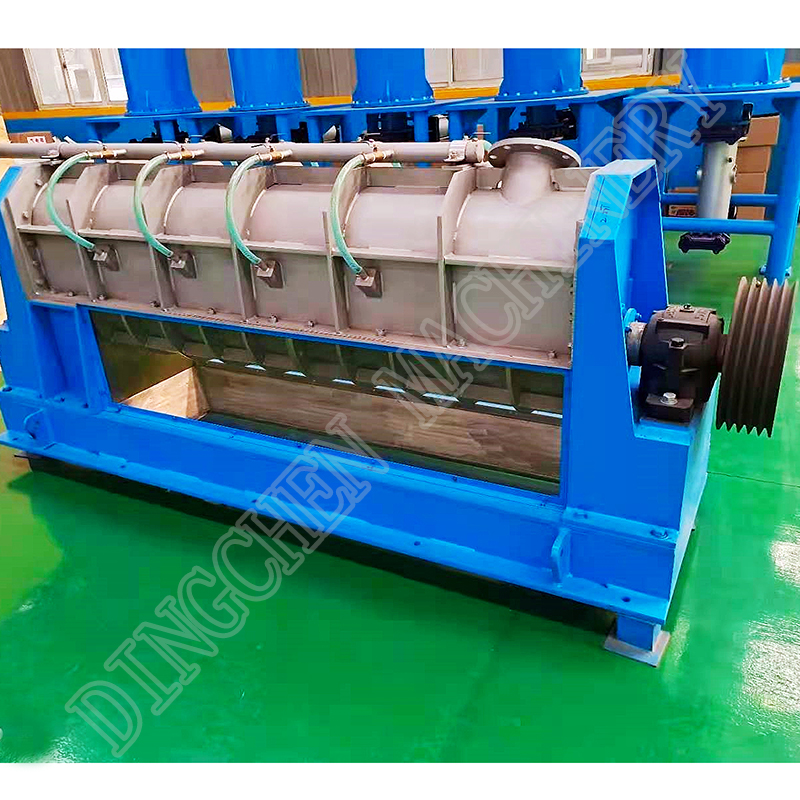
In the pulping process of the papermaking industry, raw materials (such as wood chips and waste paper) often contain impurities like sand, gravel, metal, and plastic. If not removed in a timely manner, these impurities will accelerate the wear of subsequent equipment, affect paper quality, and even cause production interruptions. As a key pretreatment equipment, the slag discharge separator has a core function of efficiently separating heavy and light impurities from the pulp. It provides clean pulp for the subsequent pulping process and serves as a crucial link to ensure the stable operation of the papermaking production line.
I. Core Working Principle: Driven by Both “Density Difference and Mechanical Separation”
The separation logic of the slag discharge separator is based on the “density difference between impurities and pulp” and achieves graded impurity removal through its mechanical structure. The mainstream technical process consists of two steps:
- Heavy Impurity Separation: After the pulp enters through the equipment’s feed port, it first flows into the “heavy impurity separation zone”. In this zone, the flow rate of the pulp slows down. Heavy impurities such as sand, gravel, and metal blocks, which have a much higher density than the pulp, quickly settle to the bottom of the equipment due to gravity. They are then discharged regularly through an automatic or manual slag discharge valve.
- Light Impurity Separation: The pulp, from which heavy impurities have been removed, continues to enter the “light impurity separation zone”. This zone is usually equipped with a rotating screen drum or a scraper structure. Light impurities like plastic pieces, fiber bundles, and dust, which have a lower density than the pulp, are intercepted by the screen drum or scraped off by the scraper. Finally, they are collected through the light impurity outlet, while the clean pulp proceeds to the next process.
II. Key Technical Parameters: Core Indicators Affecting Separation Efficiency
When selecting and using a slag discharge separator, the following parameters should be focused on to match the requirements of the production line:
- Processing Capacity: The volume of pulp that can be processed per unit time (usually measured in m³/h). It needs to match the production capacity of the front-end pulping equipment to avoid overloading or waste of production capacity.
- Separation Efficiency: A core indicator for measuring the impurity removal effect. The separation efficiency for heavy impurities (such as metal and sand) generally requires ≥98%, and for light impurities (such as plastic and coarse fibers) ≥90%. Insufficient efficiency will directly affect the whiteness and strength of the paper.
- Screen Drum Aperture: Determines the separation accuracy of light impurities and is adjusted according to the type of raw material (e.g., an aperture of 0.5-1.5mm is commonly used for waste paper pulping, and it can be appropriately enlarged for wood pulp pulping). An excessively small aperture is prone to blockage, while an excessively large one will result in the leakage of light impurities.
- Operating Pressure: The flow pressure of the pulp inside the equipment (usually 0.1-0.3MPa). Excessively high pressure can cause equipment wear, while excessively low pressure affects the separation speed. Precise control through the feed valve is necessary.
III. Common Types: Classified by Structure and Application
Based on the differences in papermaking raw materials (wood pulp, waste paper pulp) and impurity types, slag discharge separators are mainly divided into two categories:
- Heavy Impurity Separators (Desanders): Focus on removing heavy impurities. The common “vertical desander” has a compact structure and small floor space, making it suitable for small and medium-sized production lines; the “horizontal desander” has a larger processing capacity and strong anti-clogging ability, and is mostly used in large-scale waste paper pulping production lines.
- Light Impurity Separators (Slag Separators): Emphasize the removal of light impurities. The typical representative is the “pressure screen type slag separator”, which achieves separation through a rotating screen drum and pressure difference, and has both screening and slag removal functions. It is widely used in the pulping process of clean raw materials such as wood pulp and bamboo pulp; there is also the “centrifugal slag separator”, which uses centrifugal force to separate light impurities and is suitable for the treatment of high-concentration pulp (concentration ≥3%).
IV. Daily Maintenance: Key to Extending Equipment Life and Ensuring Efficiency
The stable operation of the slag discharge separator relies on regular maintenance. The core maintenance points include:
- Regular Cleaning of the Screen Drum: After daily shutdown, check whether the screen drum is blocked. If the apertures are blocked by fibers or impurities, use a high-pressure water gun to rinse or a special tool to clear them to avoid affecting the separation efficiency of the next operation.
- Checking the Sealing of Slag Discharge Valves: Leakage of the heavy and light impurity discharge valves will cause pulp waste and reduce the separation effect. It is necessary to check the wear of the valve seats weekly and replace the gaskets or damaged valves in a timely manner.
- Lubrication of Key Components: Add special lubricating oil to the moving parts of the equipment, such as the rotating shaft and bearings, monthly to prevent component damage caused by dry friction and extend the service life.
- Monitoring Operating Parameters: Real-time monitor parameters such as processing capacity, pressure, and current through the control system. If abnormal parameters occur (such as a sudden pressure increase or excessive current), stop the machine immediately for inspection to avoid equipment damage due to overloading.
V. Industry Development Trends: Upgrading Towards “High Efficiency and Intelligence”
With the increasing requirements for environmental protection and efficiency in the papermaking industry, slag discharge separators are developing in two main directions:
- High Efficiency: By optimizing the flow channel design (e.g., adopting a “dual-zone diversion structure”) and upgrading the screen drum material (e.g., wear-resistant stainless steel and high-molecular composite materials), the separation efficiency is further improved, and pulp loss is reduced (reducing the loss rate from 3% to below 1%).
- Intelligence: Integrate sensors and a PLC control system to realize the integration of “automatic monitoring, intelligent adjustment, and fault early warning”. For example, real-time monitor the impurity content in the pulp through an impurity concentration sensor, and automatically adjust the feed pressure and slag discharge frequency; if the equipment is blocked or components fail, the system can immediately alarm and send maintenance suggestions, reducing manual intervention and improving the automation level of the production line.
In conclusion, although the slag discharge separator is not the most “core” equipment in the papermaking production line, it is the “cornerstone” for ensuring the stability of subsequent processes and improving paper quality. Reasonable selection of types, control of parameters, and proper maintenance can effectively reduce production costs, reduce equipment failures, and provide key support for the efficient production of papermaking enterprises.
Post time: Oct-21-2025