

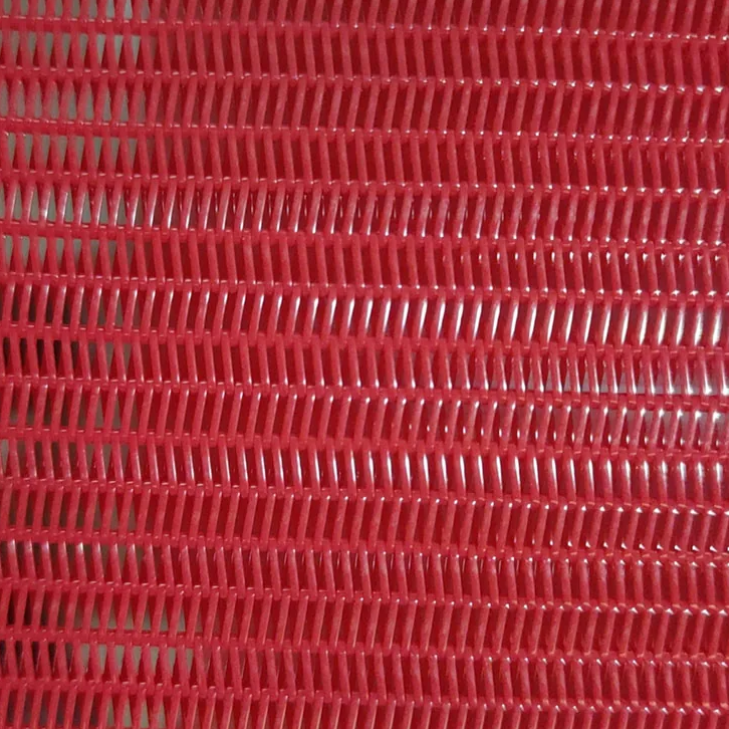
Spiral dryer fabric is a flexible dryer mesh made of polyester (PET) monofilament exclusively used in the dryer section of paper machines. Unlike the woven structure of flat-woven dryer fabrics, it is constructed by spirally winding monofilaments and interlocking them without weft yarns. It is the mainstream choice for high-speed production of high-grade paper. This article gives a precise analysis from core properties, structure, performance, and applications.
1. Core Definition & Material Properties
Spiral dryer fabric uses only high-viscosity polyester (PET) monofilament (no flat yarns). Special equipment winds monofilaments into continuous spiral loops, which are then locked by adjacent loops with a seam wire (connector wire) to form an endless belt. Some high-end versions use hydrolytically stable polyester monofilament to withstand the high-temperature and high-humidity environment of the dryer section.
Key material advantages: operating temperature 120–190 °C, acid and alkali resistance, anti-aging, low elongation, stable dimensions during long-term operation.
2. Key Structure & Classification
The spiral dryer fabric mainly consists of spiral yarns (main body, determines aperture and air permeability) and seam/connector wires (connection, determines strength and flexibility). It has no layer structure and is classified as follows:
- By cross-section of spiral yarn
- Round filament spiral fabric: general-purpose, uniform air permeability, moderate wear resistance.
- Shaped filament (e.g., oval) spiral fabric: smaller contact area with paper sheet, lighter marks, suitable for high-grade cultural paper, coated paper.
- By seam wire type
- Single seam wire: standard type, good flexibility, low tension requirement, suitable for medium-high speed.
- Double seam wire: reinforced type, higher strength, lower deformation, suitable for ultra-high speed (>1200 m/min).
- By joint type No traditional mechanical joints; all use spiral loop connection (smooth, step-less), custom-made endless belt for direct installation.
- By air permeability
- Low: <300 m³/(m²·h) for thin paper at low drying temperature.
- Medium: 300–800 m³/(m²·h) for general use.
- High: >800 m³/(m²·h) for rapid dewatering of high-moisture webs.
3. Core Advantages (vs. Flat-woven Dryer Fabric)
- Excellent flexibility and smooth running Without weft yarns, the fabric can bend freely. The joint is gap-less and step-less, with low vibration and noise even at high speed (>800 m/min), avoiding scratches and heavy mesh marks.
- Highly customizable air permeability Air permeability can be precisely controlled by adjusting filament diameter and spiral pitch, ranging from 100 to 1500 m³/(m²·h), adaptable to various drying processes.
- Better sheet surface quality No interlaced points; contact with the sheet is linear rather than point contact. Combined with shaped filaments, mesh marks and indentations are minimized, ideal for high-grade cultural paper, coated paper, etc.
- Easy local repair, low loss The interlocked spiral structure allows partial replacement of broken filaments or seam wires without replacing the whole fabric, reducing maintenance cost.
- Adaptable to special dryers Flexible structure fits curved dryers, air floatation dryers and other non-standard drying equipment, which flat-woven fabrics cannot match due to rigidity.
4. Main Limitations
- Low rigidity, easy to run off-center or wrinkle Without weft restraint, dimensional stability is lower than flat-woven fabrics. It requires high-precision tension control, guide rolls and web guiding systems; otherwise, it easily wanders, wrinkles or sags.
- Higher purchase and maintenance cost Complex manufacturing and higher material requirements lead to a 30%–50% higher cost than flat-woven fabrics of similar permeability. It also needs regular cleaning.
- Relatively lower wear resistance Without interlaced support points, local wear may accelerate in contaminated or scaled dryer environments.
- Narrow application range Not suitable for heavy paperboards (e.g., corrugated paper, linerboard, basis weight >200 g), as the fabric may deform under heavy load. Only for thin paper and specialty paper.
- Strict tension control Requires stable and uniform tension; excessive tension breaks seam wires, insufficient tension causes sagging.
5. Key Performance Indicators
- Air permeability: core index, m³/(m²·h).
- Spiral and seam wire diameter: determines strength and wear resistance.
- Breaking strength: warp (spiral) and weft (seam wire), N/5 cm.
- Elongation at break: ≤3% preferred.
- Flatness: ≤0.5 mm/m for uniform drying.
6. Typical Applications
Spiral dryer fabric is designed for medium–high to ultra-high speed thin paper and specialty paper:
- High-grade cultural paper: offset paper, writing paper, copy paper (800–1200 m/min, low marks required).
- Specialty thin paper: coated paper, lightweight coated paper, cigarette paper, security paper.
- Tissue paper: toilet paper, facial tissue on high-speed lines with curved dryers.
- Nonwovens: high-end spunlace, spunbonded nonwovens.
Not recommended: heavy paperboard, corrugated board, low-speed heavy paper production.
7. Selection & Operation Guidelines
(1) Three Selection Principles
- By speed: <800 m/min → choose flat-woven fabric (cost-effective). ≥800 m/min → spiral dryer fabric.
1200 m/min → double seam wire + hydrolytically stable polyester.
- By paper type: Thin paper (<70 g), high-grade paper → spiral fabric. Heavy paper (>200 g) → not suitable. For ultra-low marks → shaped (oval) filament spiral fabric.
- By equipment: Suitable only for machines with stable tension and web guiding systems and clean dryer sections.
(2) Four Maintenance Keys
- Tension control: maintain stable and uniform tension.
- Cleaning: regular high-pressure washing and descaling.
- Guiding system: ensure stable guide and web guide rolls.
- Protection: avoid sharp objects damaging the mesh.
8. Quick Comparison: Spiral vs. Flat-woven Dryer Fabric
| Item | Spiral Dryer Fabric | Flat-woven Dryer Fabric |
|---|---|---|
| Structure | Spiral monofilament interlocking, no weft | Warp and weft interlacing |
| Property | High flexibility, low rigidity | High rigidity, low flexibility |
| Design speed | ≥800 m/min (medium–high to ultra-high) | <800 m/min (medium–low) |
| Suitable paper | Thin paper, high-grade paper, specialty paper | All grades, especially board |
| Surface quality | Very light marks, high smoothness | Good smoothness, acceptable marks |
| Cost | High | Low, cost-effective |
| Equipment demand | High-precision tension and guiding | Standard equipment |
| Reparability | Easy local repair | Damage may spread |
9. Summary
Spiral dryer fabric is a high-end customized consumable for paper drying, with core values of smooth high-speed running and excellent sheet surface quality. However, it has higher requirements on equipment, cost and maintenance, and is not universal.
It is the optimal choice only when:
- machine speed ≥800 m/min,
- producing high-grade thin or specialty paper,
- equipped with stable tension and web guiding systems. Otherwise, flat-woven fabric is more practical and economical.
Post time: Mar-11-2026