

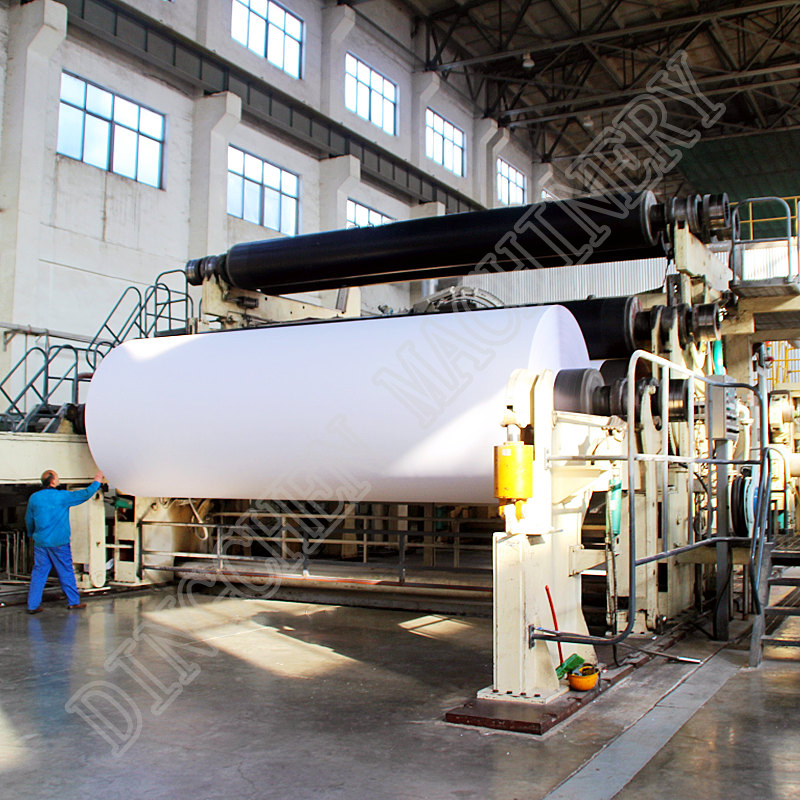
In the process of the papermaking industry transforming towards high speed and refinement, the drying section, as a key link determining paper quality and production efficiency, has never stopped iterating its equipment technology. Although traditional steam dryer cylinders can meet basic drying needs, they are prone to problems such as paper web edge fluttering, wrinkling, and breaking in high-speed production scenarios, making it difficult to adapt to the production requirements of low-quantity and high-end paper products. Against this background, VAC dryer rolls (also known as Vac rolls, i.e., vacuum dryer rolls) have emerged. With their unique vacuum adsorption and auxiliary drying functions, they have become the core supporting equipment in the drying section of high-speed paper machines, providing important support for improving quality and efficiency in the papermaking industry.
VAC dryer rolls are not traditional heating and drying components, but high-speed paper web stabilizing and auxiliary drying equipment that works in coordination with steam dryer cylinders. They are mainly used in the single-wire drying configuration of high-speed paper machines, and are commonly found in production lines for cultural paper, coated paper, white cardboard, and low-quantity corrugating base paper. Different from the working mode of traditional steam dryer cylinders that rely on internal steam supply to provide drying heat, VAC dryer rolls achieve paper web stabilization through negative pressure adsorption, and at the same time assist in accelerating the discharge of moist air, indirectly improving the overall drying efficiency, forming a coordinated drying system of “heating + paper web stabilization”.
In terms of structural design, VAC dryer rolls are mainly divided into two types to adapt to different vehicle speeds and production needs. Among them, the grooved Vac roll does not require a built-in vacuum box. The roll surface is provided with grooves of 5mm in width and 4mm in depth, and small through holes are distributed at the bottom of the grooves, with more dense holes at the edges to facilitate threading. It can generate a vacuum degree of about 2kPa when matched with an air blowing box, and the opening rate is controlled at 0.1%~0.4%, realizing paper web bonding by means of air flow negative pressure. Its structure is relatively simple, suitable for medium and high-speed paper machine production. The other type is the built-in vacuum box type Vac roll, which is equipped with precision stepped holes or dense holes on the roll shell, and a vacuum chamber adjustable according to the width inside, directly connected to the vacuum pump. It has higher vacuum degree and more precise control, specially designed for ultra-high-speed paper machines with a speed exceeding 1000m/min, which can effectively cope with the paper web stabilization problem under extreme working conditions. In some high-end production lines, Vac rolls and dryer cylinders form a precise ratio. For example, a high-grade printing paper machine with an annual output of 130,000 tons has a drying section composed of 29 steam dryer cylinders and multiple Vac rolls with a diameter of 1500mm. The lower row of traditional dryer cylinders is completely replaced by Vac rolls, realizing efficient continuous production without threading ropes and greatly improving operational stability.
The core value of VAC dryer rolls stems from their scientific working principle and performance advantages under high-speed working conditions. In actual production, the upper row of steam dryer cylinders is responsible for providing heat to evaporate the moisture in the paper web, while the lower row of VAC dryer rolls firmly adsorbs the paper web on the dry wire surface through negative pressure, effectively offsetting the centrifugal force generated by high-speed operation, and fundamentally solving the industry pain points such as paper web edge fluttering, wrinkling, and breaking. At the same time, the air flow in the pocket ventilation is sucked into the roll holes, accelerating the discharge of moist air, breaking the moist air retention layer on the paper web surface, and indirectly improving the drying rate. In the threading stage, the design of dense holes at the edges can enhance the adsorption effect, significantly improve the threading success rate, and shorten the threading time. The transformation case of Lee & Man Paper’s PM15 paper machine fully confirms this. After transforming the original double-hung dryer cylinders into single-hung dryer cylinders and upgrading them to Vac rolls, combined with optimized stabilizing boxes and pocket ventilation equipment, the paper web breaking rate was reduced by 60%, unplanned downtime was reduced by 30%, and when producing 70~90g/m² corrugating base paper at a speed of 1000m/min, the average monthly paper breakage was only 10 times, and the production efficiency was increased by 3%.
Compared with traditional steam dryer cylinders, the functional positioning of VAC dryer rolls is more inclined to paper web stabilization and auxiliary drying, and the two form a complementary and coordinated relationship. In terms of heat source supply, VAC dryer rolls have no built-in heating structure and rely entirely on negative pressure for operation, while steam dryer cylinders use steam as the heat source and undertake the core heat transfer and drying tasks; in terms of surface structure, VAC dryer rolls adopt grooved or drilled designs, while steam dryer cylinders mostly have smooth chrome-plated or cast iron surfaces; in terms of functional focus, VAC dryer rolls focus on paper web width stabilization, auxiliary dehumidification, and reduction of paper defects, while steam dryer cylinders focus on efficient heat transfer to complete the main evaporation of moisture in the paper web. In terms of drying capacity, the drying capacity of a single VAC dryer roll is limited, and about 2~3 Vac rolls are equivalent to one standard dryer cylinder. Therefore, in practical applications, it is necessary to scientifically match the number of Vac rolls and steam dryer cylinders according to the vehicle speed and paper quantity to achieve a balance between efficiency and cost.
Under the background of the advancement of the “dual carbon” strategy and the intelligent and energy-saving transformation of the papermaking industry, the application of VAC dryer rolls also needs to take into account energy consumption control and maintenance optimization. VAC dryer rolls need supporting vacuum and ventilation systems, and compared with traditional drying configurations, their energy consumption and maintenance costs are slightly higher, but energy saving and consumption reduction can be achieved through technical optimization. For example, Lee & Man Paper upgraded the SymRun vacuum box during the transformation, reducing the load of the air supply fan by 30% while improving the vacuum degree; Valmet Finland optimized the spacing between Vac rolls and dryer cylinders through 3D scanning and modeling, increased the paper web dryer wrap angle, reduced the number of blowers and air pipelines, and lowered energy consumption and maintenance costs. In daily maintenance, it is necessary to regularly backflush the holes and grooves of the Vac roll with compressed air to prevent clogging, check the vacuum sealing performance and bearing temperature at the same time, and control the vacuum degree within the process requirements. Matching with efficient pocket ventilation and heat pump systems can significantly improve the overall drying efficiency and reduce steam consumption.
With the continuous upgrading of high-speed paper machine technology and the growing demand for high-end paper products, the technological iteration of VAC dryer rolls will also move towards precision, energy conservation, and intelligence. In the future, with the help of cutting-edge technologies such as CFD simulation and numerical calculation, the hole design and vacuum chamber structure of Vac rolls can be further optimized to improve the negative pressure control accuracy and paper web bonding degree; combined with intelligent sensing and big data analysis, dynamic regulation of vacuum degree can be realized to adapt to the production needs of different paper types and different vehicle speeds; at the same time, through material upgrading and structural optimization, equipment energy consumption and wear can be reduced, and service life can be extended. As a “quality stabilization tool” for high-speed papermaking drying systems, VAC dryer rolls not only solve many pain points of traditional drying configurations under high-speed working conditions, but also help papermaking enterprises improve product quality and optimize production efficiency, injecting new momentum into the high-quality development of the papermaking industry.
Post time: Feb-03-2026